
Flores
Information
Flores Island
Geography
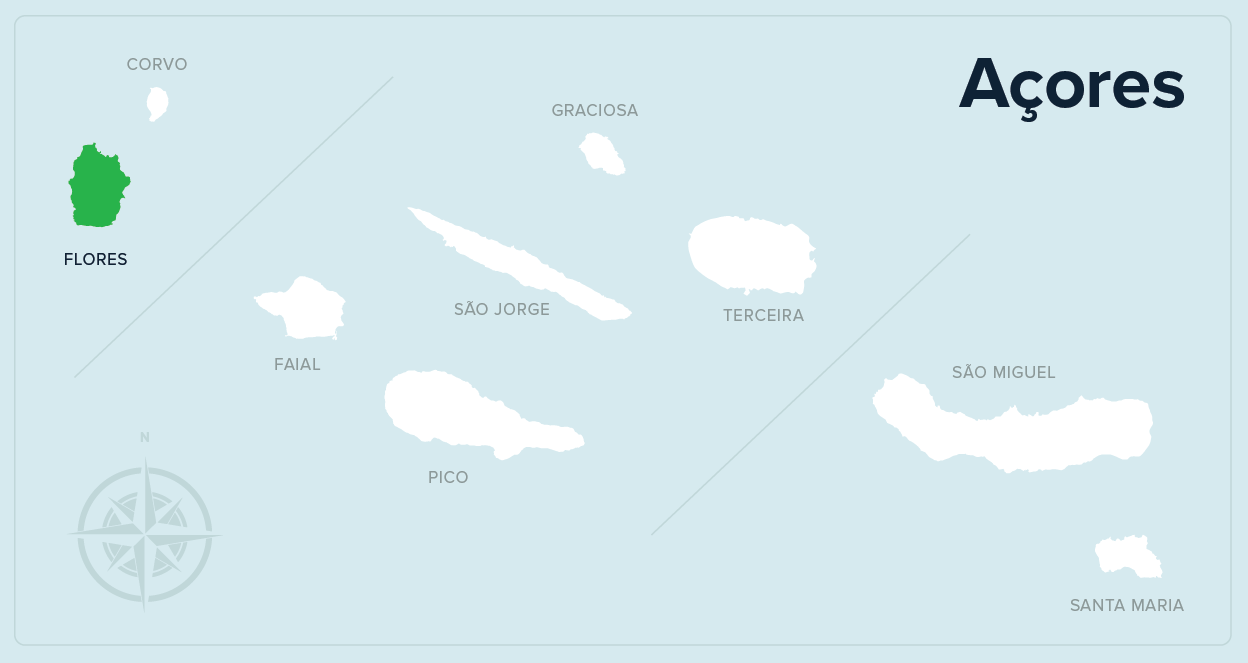
In shape trapezoidal and stretching north-south, it is the sixth island in the archipelago in terms of surface area, covering 143.11 km2 (about 17 km by 12.5 km). Its central platform, which develops between 500 and 600 metres above sea level, has a maximum altitude of 914 metres, at Morro Alto.
Activities
Information
Other Information
The island of Flores, situated at the westernmost point of the Azores archipelago, was classified as a Biosphere Reserve by UNESCO's Man and the Biosphere (MaB) programme in 2009. It includes the whole of the island's emerged area and an adjacent marine zone, covering a total area of 58,619 ha, and contains unique landscape, geological, environmental and cultural values at regional, national and international level.
This island impresses with its breathtaking cliffs, volcanic craters transformed into lagoons, waterfalls and dense vegetation full of endemic species. Its natural landscape is one of the great attractions of both the island and the archipelago. Its most emblematic natural features include: Rocha dos Bordões, a remarkable Natural Monument made up of vertical basaltic columns caused by ancient lava flows; the Morro Alto and Pico da Sé Nature Reserve, with the highest point on the island - Morro Alto, at 914 metres; or Poça do Ferreiro, with its breathtaking waterfalls, one of the most idyllic places on the island.
The network of walking trails allows visitors to explore the island's landscape, flora and fauna in a sustainable way, enjoying a unique and memorable experience in full contact with nature.
In addition to its natural beauty, the island of Flores keeps alive its cultural traditions and sustainable ways of life, closely linked to the territory and respect for nature. Its inclusion in the World Network of Biosphere Reserves underlines the island's commitment to environmental preservation, the enhancement of local practices and its balanced and sustainable development.
Links:
The date of the discovery of the islands of Flores and Corvo is controversial, and it is known that it was later than that of the other seven islands of the Azores. It is said, however, that in 1452 it was recognised by Diogo de Teive and his son. Initially called the island of São Tomás or Santa Iria, its name was soon changed to Flores, due to the abundance of yellow flowers (cubres), which covered the entire island, and whose seeds were possibly brought from the Florida peninsula, North America, in the feathers of migrating birds. Its initial settlement is attributed to the Flemish Wilhelm van der Haegen who, after a few years, abandoned it and settled on the island of São Jorge, a decision that was due to the island's remoteness and the lack of regular boat connections that would allow the dye plant (known as pastel) to be exported to Flanders.
In the 16th century, farmers from different regions of the mainland began ploughing their fields, producing wheat, barley, maize and vegetables, as well as harvesting heather - a liquen used in dyeing - and pastel. During this period, the villages of Lajes and Santa Cruz were granted town charters.
Far from the rest of the archipelago, with few products to export, the island of Flores lived for centuries in near isolation, interrupted by rare visits from the royal authorities, trading boats from the islands of Faial and Terceira, which came to collect sperm whale oil, honey, cedar wood, butter, lemons and oranges, smoked meats and sometimes ceramic crockery, leaving woollen and linen cloths and other items in exchange.
This isolation did not prevent the island from being attacked in 1587 by an English fleet, which plundered it, and by other privateer and pirate ships (one of which, tradition has it, took refuge in the Enxaréus cave), which also attacked and pillaged the island.
The American whaling ships that travelled to the Azores from the middle of the 18th century until the end of the 19th century used the waters to hunt sperm whales and, among the population, they recruited sailors and harpooners, many of whom became sailboat captains. It is worth mentioning the "Wanderer" which, having sailed until 1924, was considered the most beautiful American whaler.
The development of agriculture and cattle breeding, the improvement of harbour facilities, the construction of an airport and the presence of a French telemetry station are some of the recent events that have opened up new horizons for the island's progress.
Queijo Curado da Ilha das Flores
Cheese with a soft paste and a firm texture
Linguiça com Inhame
Typical sausage, served with yams
Pastéis de Algas
Just like the Erva Patinha Pies, the concept of an omelette is paired with the seaweed that grows in the island's seas
Sopa de Agrião
It's a soup whose ingredients are watercress, potatoes, salt and garlic, and is served with cornbread
Cozido de Porco à Moda das Flores
Pork dish soaked in salt brine which, after being soaked, is boiled and served with potatoes and cabbage
Caldeirada de Congro
The abundance of fish in the Azorean seas has greatly influenced the gastronomy of the islands, where it is typically prepared in stews or simply fried. On Flores, the most common species is conger eel, the main ingredient in the island's stews
Albacora Assada
Yellowfin tuna is a fish of the genus Thunnus, one of the eight known species of tuna, very abundant in the Azorean seas. Roasted and served with potatoes, it is a gastronomic delicacy on the island of Flores
Batata Doce à Moda das Flores
On the island of Flores, this potato can be boiled traditionally or baked in the oven and wrapped in flour
Torresmos de Banha e Torresmos de Carne
Small portions of pork prepared in a vinha-d'alhos (white wine, vinegar amd garlic). The ingredients vary from parish to parish. For example, in Fajãzinha cinnamon and cumin are used, which gives it a more intense flavour compared to the other parishes on the island
Lapas
This is a popular shellfish in the Azores archipelago, and on the island of Flores they are prepared in Afonso sauce, a sauce made from olive oil, onion and garlic
Papas de Carolo ou Papa Grossa
Once the corn has been harvested and is still green, it is ground in a mill, resulting in carolo (incomplete grinding of maize grains). This is sieved continuously until it is ready to be cooked with milk, thus giving rise to Carolo porridge
Bolo do Tijolo
This cake, typical of the island of Flores, is made with cornflour, wheat flour, water and salt. Once the dough has rested, it is shaped into several balls, flattened to go into the brick (made from clay) and then put into the fire.
Festas do Espírito Santo
These festivities are common to all the islands, although they differ in some details from island to island and even within the island itself. Around each island, every parish has a chapel - the “Império” - with its own brotherhood. These are considered to be the most characteristic religious festivities in all of the island's ethnography. They celebrate the third person of the Holy Trinity where the spirit of community and sharing reflects the true nature of these celebrations.
Location: All over the island
Date: From May to September, with special emphasis on the seventh Sunday after Easter
Responsible Entity: Brotherhoods of the Holy Spirit
Festa do Emigrante
A popular festivity in honour of emigrants who return to their homeland in the summer. It's an opportunity for many to see other fellow adventurers again who, after arriving in the new country, were separated for a number of reasons.
Location: Lajes das Flores
Date: 17th to 20th July (Third weekend of July)
Entidade Responsável: Câmara Municipal das Lajes das Flores
Festa do Cais Das Poças
In recent years, it has become the main festival in the municipality of Santa Cruz. It features nationally, regionally and locally renowned artists. It includes an important fair for the island's economic activities. In short, it's a festival where you can enjoy concerts, restaurants and taverns with typical food, as well as the promotion of local products and handicrafts, sports tournaments, a procession of ‘experiences and traditions’ and the typical fish broth, served to the population and visitors.
Location: Santa Cruz das Flores
Date: 31st July to 3rd August, first weekend in August
Responsible Entity: Santa Cruz das Flores Town Hall

